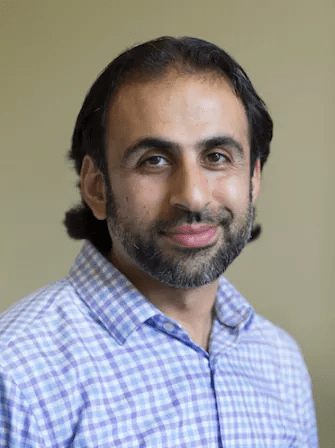
Umar Abdul Rahman, Muslim Student Advisor (credit: Swarthmore College)
Umar Abdul Rahman is the Muslim Student Advisor at Swarthmore College. This interview was conducted by Wyatt Brannon ’26 and Lou Williams ‘27 of The Mayor’s Editorial Board.
WB: How are you doing today, Umar?
UAR: I’m doing all right. There was a film shown on Monday that was interesting. I guess not too many students knew about it. It had a really prominent Palestinian actress. Her daughter is a director. It’s called Bye-Bye Tiberias. It was about four generations of Palestinian women and their lives. Primarily the actress Hiam Abbass is really well known, but I guess maybe not so much by the younger generation or in the US. It was a really thought provoking documentary.
WB: Glad to hear that you enjoyed it.
UAR: Yeah, it was kind of one highlight of the week.
LW: How long have you been at Swarthmore?
UAR: This is my tenth year. Initially the position was not a part of the college. From what I remember it was supported through presidential funding [from the College President’s Office]. Some students had petitioned to have a Muslim chaplain. There was somebody in my position beforehand and then I came on like a year and a half after this other person left and moved to Minnesota for family reasons. So I applied for the position, and fortunately I got it. And I then started the fall of 2015. And I believe the position may have been like that for a year, maybe two years, and then they made it a part-time college position, and then it became full-time. It was pretty close to full-time anyways at that point after three or two years.
WB: And when you say presidential funding, do you mean like US government funding?
UAR: Oh, the President’s Office [of the College]. They said it was soft money through the President’s Office. I don’t know exactly what that means. There was this petition to have more chaplains, especially a Muslim chaplain. They call me a Muslim advisor here. And so the President’s Office felt like they needed to invest in and help develop religious life even more. Religious life here was not directly funded by the college for quite some time. I imagine the student groups would always have been funded through OSE, but in terms of other positions, it was more similar to our affiliate advisors where there’s outside organizations that fund the position. And so, particularly with the Christian life position, our colleague Joyce Tompkins was in that role. And I think it was supported through Partnerships in Ministry, and that may have been the same group that had supported Sabrina initially. The college took over the endowment and made both college positions, which I think is good for everybody. Gee, to be a part of the college is definitely better than being supported by an outside group – there’s some advantages to both, you could say, but overall, it’s definitely better to be a part of the College and part of the team.
And we were all the way over in Bond [Hall]. I was talking to some first-years and they didn’t even know where it was. But it did feel like you were a little isolated. There’s some advantages to being in that setting and being a little bit isolated, especially for religious life, as you have a quiet atmosphere. But overall, it’s definitely better to be around students. They can just pop in when they see your office. So I think that was nice when we were able to move to this building, which was 2018. If you see the sign, it says it was dedicated sometime in 2018. So see, that was a big change. Definitely a game changer here, to be over here, to have three full time positions.
WB: And you work with Villanova as well?
UAR: I alternate with the Muslim chaplain there; we just alternate Friday prayers, so students here get an opportunity to hear from our affiliate advisor, Asheq, who’s now actually the first full-time chaplain at Drexel. I don’t know where he gets the energy from, but he serves as our affiliate advisor here. He’s an additional support for Muslim students.
What happened was Villanova was doing a Friday prayer and they invited me to lead it. That was my first year, the fall of 2015. And so I went over there and it was a really nice vibe. I asked them if they wanted us to continue doing it, and then Asheq jumped on board and eventually he became more involved. He’s more official there. For me it was more like volunteering and allowing students to hear from different voices.
LW: What’s your favorite college then, since you’ve done work at so many? Which is the best?
UAR: Oh, definitely Swarthmore! Villanova is voluntary; it’s just like two hours on a Friday. I just go there and come right back. It’s not too much of a commitment.
LW: You work really closely with the MSA. I was wondering if you could tell us about what you do for Muslim student life on campus.
UAR: Awesome question. I guess primarily it’s supporting the MSA, but also just in general being available for Muslim students. The MSA is pretty active, so they definitely keep me busy and they do a fabulous job. I assist them in their events, help them find various speakers when they want to bring them to campus, and work to establish religious programming primarily like the Friday prayers and Quran Circle. And then also just being available for students, whether they’re in the MSA or outside. I’m able to answer questions about Islam and particularly the breadth of the tradition. That’s always something I try to focus on.
WB: You are, of course, not always working. What do you do for fun? Do you have any pets or anything like that?
UAR: No pets. Good question. Maybe not enough! Lately I started taking some MMA kickboxing classes. It’s still in the early phases. I enjoy watching that though. I thought that might be helpful trying to get in shape. I think it’s important to just be physically fit and active and I don’t always do enough of that. I noticed that I need to make a more serious commitment to staying physically active.
Traveling is something I enjoy doing too. I haven’t done too much of that, especially international travel, but it’s definitely enjoyable. The most recent place I went to internationally would have been Iran, which was really nice. I went on the trip with Hartford Seminary. I got an opportunity to visit family I’m not otherwise able to to visit; I do have quite a bit of family there and then also in Pakistan.
Most of the Pakistani side of the family has moved to the US, and that’s primarily where I grew up: in a culturally Pakistani-American household. We have ties to both Iran and Pakistan, but culturally I always grew up more on the Pakistani side. My mother was half Iranian and half Pakistani, but she grew up in Pakistan. And my father’s Pakistani.
WB: What does the Interfaith Center do more generally? What kind of initiatives are you working on right now?
UAR: A big part of what we do, in addition to supporting the different religious traditions, would be helping students whose tradition is not represented on campus, or who might belong to a minority tradition, get to places of worship: connecting them to places of worship where they can practice their faith tradition. Then we do broader events with the campus, things like meditations, vigils, meditations, a bereavement group. There is also Awakened Awareness, a series of workshops led primarily by my colleagues, dealing with the spiritual wellness of students on college campuses.
We also work with our Interfaith Center interns who do some great projects – we call them passion projects – centered around different areas of interest related to religion, spirituality, and their own interests. They can range across so many different things. We have one intern who’s leading a class on Mormonism. We’ve had some projects in the past about racial identity and religion and LGBTQ identity and religion. We’ve had some projects on Quakerism, especially since we have ties with Quakerism. Some projects related to dialogue, religious literacy projects, raising awareness about different religions and different beliefs, even some projects related to music and religion. Some of our interns have done a lot of work related to social service as well.
WB: We’re glad to hear that y’all are involved in the community and getting out there each day to help students.
LW: What is the benefit of engaging with spiritual life on campus for students who maybe aren’t religious?
UAR: I think when it comes to spiritual wellness, we oftentimes are associated with different religions, and while that’s partly true, I think spiritual wellness is much broader than that. They normally define it as being connected to something greater than yourself. Oftentimes it is going to be a connection to the divine or God, but they even talk about spirituality being just connecting oneself to other beings in creation. Just being connected to nature, even, is a form of spirituality; being connected to other humans, it’s a form of spirituality. So it’s much broader than just being connected to a particular religion. Everybody does have a spiritual path, you could say, or just the search for what your purpose in life is: and just trying to reflect upon that, that’s also a form of spirituality. It’s really more than belonging to a particular religion, and religions generally also address more broader concepts as well. I think we can always benefit from what religions collectively say about various issues. For instance, when we hold a bereavement group, it isn’t connected to any religion, but sometimes religions may have resources that we can turn to, such as general concepts related to how to handle loss and grief. One doesn’t have to belong to a religion to appreciate the lessons that we can gain from different religions and spiritual paths.
WB: Broad question: how can students be better allies to their Muslim peers?
UAR: In general, in a place like Swarthmore, I think students are pretty open and accepting, welcoming, and inclusive of others. Overall, I think there’s positive relationships that I see between Muslim students and other students. But sometimes being more aware of some of the practices – for instance, when Ramadan happens, just being aware that your peers are fasting can be helpful to them. Obviously, if you know somebody’s fasting, you’re gonna keep that in mind in terms of how you approach them.
WB: Maybe not schedule lunch with them.
UAR: Right. Yeah, things like that. If you don’t invite them to lunch, that would be beneficial. Or just being mindful of the fact that their energy levels may not be so high. Everybody approaches fasting and reacts to fasting differently. For some people, they may have more energy early on, some later on. I think that’s alway on students’ minds when Ramadan comes up. It is a concern, like, how we’re going to handle classes and various extracurriculars. And so I think the faculty, staff, and students just being more mindful of the practices would be helpful.
WB: And Ramadan is coming up.
UAR: Yep. It’s on a lunar calendar, so we don’t always have the dates right away. And that’s a whole ‘nother issue. Sometimes people use a calculated method versus actual moon sightings; there’s some debate in the Muslim community, so the days can sometimes vary like one or two day. But, for the most part, you could say it’s essentially all of March. I think the first day of fasting should be March 1st if I’m not mistaken. Then it lasts 29 or 30 days, and then the holiday will follow that.
WB: And that’s Eid?
UAR: Yeah. One of the Eids, yeah.
WB: Is there anything else that you’d like students to know about, regarding the Interfaith Center or Muslim student life?
UAR: Over the years the population has grown quite a bit – I’d probably estimate the Muslim student population to be close to like 50 to 60 students. There’s varying ways of involvement with the MSA amongst those students. But what I really like about the MSA is that it’s welcoming to everybody. I know that’s not always the case around the country at other MSAs. When I was in college, it tended to be more for the highly observant. So I think that’s something I appreciate, particularly at the liberal arts colleges and maybe the Ivy Leagues, is that you tend to have a very inclusive and welcoming atmosphere where anybody who identifies as Muslim is welcome as well as others want to learn about the faith or even just be in fellowship with people who belong to the Muslim faith.
In fact, even the MSA board has oftentimes had people, if I’m not mistaken, who were of other faiths. I mean, they’re primarily Muslim students, but at times they’re open to having a board member from other faiths. I really appreciate that aspect of the MSA, that they do have that welcoming vibe. For a while it was defunct, and then there was a student who was here, guess maybe like in 2012-ish, who decided to kind of revive the MSA and develop this type of ethos of welcoming everybody and being a supportive space for everyone. He worked with the Muslim advisor at the time, and other students, and then we just picked up the baton and carried it forward. It’s really grown since that time period. Now it’s a very active group, maybe one of the most active on campus. I appreciate the MSA and the commitment that they put in. I just want for other students to know that they’re always welcome to come to events.
WB: Well, we will keep that in mind. And we’re glad to hear the students are benefiting from all of that. Thank you so much for this interview. We really appreciate it.
LW: Thank you so much.
 The Swarthmore Mayor
Leave a comment